
My Educational Philosophy
Reincarnation is one of the topics with differing opinions, making it debatable. However, if it is true, according to many world religions, only knowledge can be carried with us if we are reborn on earth. This makes it easy to understand the power of knowledge. One can gain this knowledge by getting educated. Due to this reason, education is considered to be the best gift ever. Therefore, the teaching profession is regarded as a noble profession. I feel incredibly privileged to be a part of the world’s teacher’s fraternity. Another similar concept that I learned from the movie “Lucy” where the actor Morgan Freeman explains that the only purpose of life is to pass on the knowledge that we gain to the next generation. This has been happening ever since the first cell split into two.
Considering the above perspectives, everyone has a right to gain knowledge. As a teacher, I ensure that every child learns well. Every child is unique and takes time to learn and understand. Our duty as educators is to make sure that they are comfortable and hesitant free to ask questions, which will make the learning process more live and effective. I use the differentiation method in the class to ensure that every child learns at their pace. It helps maintain the interest of children in education.
A passion for teaching various courses
I have taught the following courses in various curricula, including BC’s Curriculum (Secondary), Cambridge (IGCSE, AS, and A Level), and CBSE (Secondary and Senior Secondary).
Computer Science
Explores the theoretical foundations of computing and algorithms.
Topics include data structures, software development, artificial intelligence, and machine learning.
Often involves project-based learning and real-world applications.
IT
Focuses on using computers, networks, and software applications in business and everyday life.
Covers hardware, software, networking, cybersecurity, and cloud computing.
Practical skills include troubleshooting, system administration, and IT support.
Robotics
Combines engineering, programming, and electronics to create autonomous machines.
Involves hands-on learning with kits like LEGO Mindstorms, Scratch, or m-Bot.
Covers topics like sensors, actuators, automation, and artificial intelligence.
ICT
Encompasses digital communication tools like emails, video conferencing, and social media.
Covers how technology supports communication, collaboration, and data management.
Often includes digital literacy, online safety, and multimedia tools.
Workplace Mathematics
Focuses on practical math skills used in real-world job settings.
Topics include financial literacy, measurement, data analysis, and problem-solving.
Helps students apply mathematical concepts in business, engineering, and construction industries.
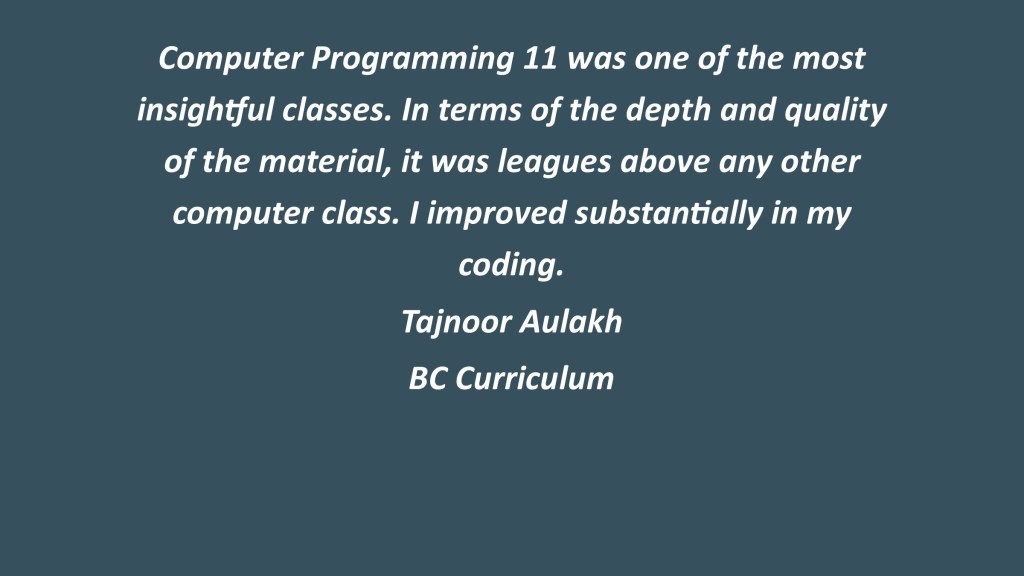
Computer Programming
Teaching how to write code using languages like HTML, CSS, Java, C++, or JavaScript.
Focuses on problem-solving, algorithm development, and debugging.
Includes hands-on exercises like creating simple programs, games, and applications.


 N. R. Chawda